

The many facets and challenges of immigration policy is not new, but it has become top of mind for many Catholic Kansans and indeed all citizens. Recently, the Kansas Catholic Bishops have issued pastoral statements designed to guide the faithful. These are posted below.
Pastoral guidance lights the way to policy positions. The dignity of the human person—in this case, the migrant—is critical. We seek policies that uphold human dignity, but likewise support the rule of law and the role of law enforcement. This is not an easy path, but we must persevere for the common good.
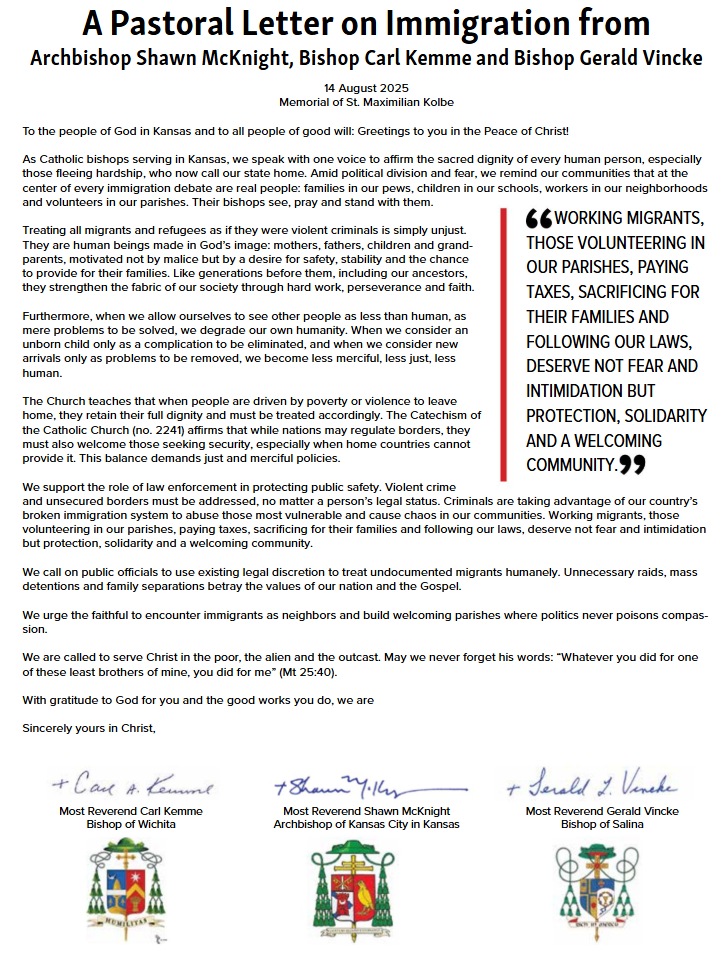
Immigration: What is God’s plan for us? (Ver documentos en Español al final)
Bishop John B. Brungardt's Column
September 7, 2025, Southwest Kansas Catholic
Before I formed you in the womb I knew you, before you were born, I dedicated you” (Jeremiah 1:5). All persons are children of God: male, female, adults, children, the unborn, of every race, country, and background. When we have a difficulty with someone, do we first see a child of God, or do we see a conflict, a political party, a controversial issue? How do we resolve difficulties? Do we start with prayer and dialogue, or with a meme, cartoon, harsh word or uncharitable post? What would the Lord Jesus Christ our Savior do?
The topic of immigration is one of these difficulties. Remember from Sacred Scripture: “The Lord protects the resident alien, comes to the aid of the orphan and the widow” (Psalm 146:9). Let’s review seven key Catholic Church teachings about immigration:
1. Persons have the right to find opportunities in their homeland (i.e., the right not to migrate).
2. When the conditions necessary for a dignified life are absent, persons have the natural right to migrate to support themselves and their family.
3. More prosperous nations are obliged, to the extent they are able, to welcome those in search of the security and means of livelihood unavailable in their country of origin.
4. Countries have the right to maintain their borders and regulate immigration, consistent with the common good and with respect for the sanctity of human life.
5. Refugees and asylum seekers should be afforded protection.
6. The God-given dignity and rights of undocumented immigrants should be respected.
7. Immigrants have a responsibility to respect the country that receives them.
All of these are important, but let’s look at two of these key teachings. Having open borders – borders without required processing – would be an extreme response to teaching #2. We can see how traversing the border without required processing has resulted, for example, in cases of human trafficking, drug/arms smuggling, gang/cartel violence and unaccounted for unaccompanied minors, all grave injustices.
Having closed borders – refusing entry to immigrants and refugees – would be an extreme response to teaching #4. We can see how refusing entry in any case has resulted, for example, in an uncharitable lack of care of people escaping from war, death threats, poverty or injustices. Another injustice has been removing undocumented immigrants without due process.
Rarely does an extreme response work. Compassion without justice could lead to anarchy. Justice without compassion could lead to cruelty. What to do?
“Cast all your worries on him because he cares for you” (1 Peter 5:7). We start with prayer to our Loving Lord, individually and as a faith community, asking for wisdom, patience, justice and charity. We then dialogue, truly getting to know people who are different from us. I asked during a homily: “What language did your great-grand parents speak?” For folks my age and older, I rarely get the answer “English.” In this part of the state, the common answers are German or Spanish. Thus, we do not have to go back very far in our own families to find an immigrant. How would we treat our own family members now if they were immigrating to the United States?
We work within our legislative, executive and judicial branches to find just and compassionate solutions. For many years some elected officials have said there will be no real progress on the immigration issue until and/or unless the border is secure. This now appears to be happening (secure border)—so now is the time for our elected officials to get truly serious about addressing the immigration issue, beginning with those who were brought to the U.S. as children, who are here through no fault or action of their own. Also, progress can be made on various “guest worker” programs, which have been discussed by both major political parties. Care must be taken to ensure the poor are not neglected, regardless of their immigration status. These steps could lead to further reforms. Comprehensive immigration reform has been needed for decades. Please contact your federal representatives and senators. We also pray for our dedicated law enforcement personnel who enforce existing laws.
A new awareness for many regards our numerous missionary priests and religious sisters who have generously and sacrificially served in the Catholic Diocese of Dodge City and around the country. Recent changes to the immigration process may soon leave some of our parishes without missionary priests or religious sisters. In a recent article (search “Rubio religious worker visa”), United States Secretary of State Marco Rubio discussed the need to fix the religious worker visa backlog. Please contact your federal representatives and senators.
Let us all be compassionate and caring to those who live in fear and worry. We are all brothers and sisters in Christ, who calls us to be united in mutual love: “that they may all be one” (John 17:21). Prayerfully ask the Lord how you can assist.
To undocumented immigrants: “The Lord is close to the brokenhearted, saves those whose spirit is crushed” (Psalm 34:19). Be assured of my prayers for you and your family. You can call the Catholic Church your home. We love you. Ask Jesus and His Mother Mary to hold your hands. Our Lord loves you more than you can ask or imagine!
Immigration: What is God’s Plan for Us? (Part II)
October 5, 2025, Southwest Kansas Catholic
“For through faith you are all children of God in Christ Jesus” (Galatians 3:26).
All persons are children of God, brothers and sisters in Christ. Last month I wrote about immigration; first, how Sacred Scripture and Catholic Magisterial teaching informs us about this important issue. I then gave some starting points in a call to action: To pray, to get to know someone or a family who is different than you, and to be involved in the political process. This article gives some additional ideas of what we can do in our own families, parishes and communities to treat immigrants and refugees as our brothers and sisters in the Lord. May we, in our homes, parishes and neighborhoods:
· Accompany our brothers and sisters who are immigrants and refugees
· Have personal conversations
· Invite to family, parish and diocesan activities
· Build up and encourage all our immigrants, as St. Paul says: “Therefore, encourage one another and build one another up, as indeed you do” (1 Thes 5:11)
· Pray, speak and live hope in Christ, love in the Lord, faith in our Trinitarian God
· Speak and live peace, modeled after the Prince of Peace, Jesus
· Claim our dignity and freedom as children of God
· Show compassion – as we suffer with others who are in distress. “While he was still a long way off, his father caught sight of him, and was filled with compassion. He ran to his son, embraced him and kissed him” (Luke 15:20)
· May we all be Pilgrims of Hope (Jubilee 2025 theme), as hope comes from communion
· Follow Jesus, who said many times “Be not afraid” (cf. Matthew 14:27; Mark 5:36; Luke 8:50; John 6:20)
· Share and discuss these two articles in your family and in parish groups
· Contact your local Church or the Diocese for ideas of how to assist
· Assist with your time, abilities, charisms and almsgiving: local charities, food pantries, thrift stores, or baby items charities
· Contact your Congressional Representative and two Senators
· Pray a Holy Mass for immigrants and refugees
· Add a Prayer of the Faithful at Holy Mass for the intention of immigrants and refugees
· Pray, pray, pray, asking the Holy Family of Jesus, Mary and Joseph (immigrants to Egypt) for their help
· Your ideas?
The root of this issue is the dignity of the human person, a constant theme of Pope St. John Paul II. Ask the Lord in your prayer how to love each person in a deeper way. May we unite in love as a family of God. Jesus loves all His children more than we can ask or imagine!
“In this is love: not that we have loved God, but that he loved us and sent his Son as expiation for our sins. Beloved, if God so loved us, we also must love one another” (1 John 4:10-11).
________________________________
Inmigración: ¿Cuál es el plan de Dios para nosotros?
Antes de formarte en el vientre materno, te conocí; antes de que nacieras, te consagré (Jeremías 1,5). Todas las personas son hijos de Dios: hombres, mujeres, adultos, niños, no nacidos, de cualquier raza, país y origen. Cuando tenemos un problema con alguien, ¿vemos primero a un hijo de Dios o un conflicto, un partido político, un tema polémico? ¿Cómo resolvemos las dificultades? ¿Comenzamos con la oración y el diálogo, o con un meme, una caricatura, una palabra dura o una publicación poco caritativa? ¿Qué haría el Señor Jesucristo, nuestro Salvador?
El tema de la inmigración es uno de estos problemas. Recordemos la Sagrada Escritura: «El Señor protege al extranjero, ayuda al huérfano y a la viuda» (Salmo 146,9). Repasemos siete enseñanzas clave de la Iglesia Católica sobre la inmigración:
1. Las personas tienen derecho a encontrar oportunidades en su patria (es decir, el derecho a no migrar).
2. Cuando no se dan las condiciones necesarias para una vida digna, las personas tienen el derecho natural Migrar para mantenerse a sí mismos y a sus familias.
3. Las naciones más prósperas están obligadas, en la medida de sus posibilidades, a acoger a quienes buscan la seguridad y los medios de subsistencia que no están disponibles en su país de origen.
4. Los países tienen derecho a mantener sus fronteras y regular la inmigración, de acuerdo con el bien común y con el respeto a la santidad de la vida humana.
5. Se debe brindar protección a los refugiados y solicitantes de asilo.
6. Se debe respetar la dignidad y los derechos otorgados por Dios a los inmigrantes indocumentados.
7. Los inmigrantes tienen la responsabilidad de respetar al país que los recibe.
Todas estas son importantes, pero veamos dos de estas enseñanzas clave. Tener fronteras abiertas (fronteras sin el trámite requerido) sería una respuesta extrema a la enseñanza n.° 2. Podemos ver cómo cruzar la frontera sin el trámite requerido ha resultado, por ejemplo, en casos de trata de personas, tráfico de drogas y armas, violencia de pandillas y cárteles, y menores no acompañados desaparecidos, todas ellas graves injusticias.
Tener fronteras cerradas (negar la entrada a...) Inmigrantes y refugiados: sería una respuesta extrema a la enseñanza n.° 4. Podemos ver cómo negar la entrada, en cualquier caso, ha resultado, por ejemplo, en una falta de atención desinteresada hacia quienes huyen de la guerra, amenazas de muerte, pobreza o injusticias. Otra injusticia ha sido la expulsión de inmigrantes indocumentados sin el debido proceso.
Rara vez funciona una respuesta extrema. La compasión sin justicia puede conducir a la anarquía. La justicia sin compasión puede conducir a la crueldad. ¿Qué hacer?
«Echen todas sus preocupaciones sobre él, porque él cuida de ustedes» (1 Pedro 5,7). Comenzamos con una oración a nuestro Señor amoroso, individualmente y como comunidad de fe, pidiendo sabiduría, paciencia, justicia y caridad. Luego dialogamos, conociendo verdaderamente a personas que son diferentes a nosotros. Pregunté durante una homilía: «¿Qué idioma hablaban sus bisabuelos?». De personas de mi edad y mayores, rara vez recibo la respuesta «inglés». En esta parte del estado, las respuestas comunes son alemán o español. Por lo tanto, no tenemos que remontarnos mucho en nuestras propias familias para encontrar un inmigrante. ¿Cómo trataríamos a nuestros familiares ahora si emigraran a Estados Unidos?
Trabajamos con nuestros poderes legislativo, ejecutivo y judicial para encontrar soluciones justas y compasivas. Durante muchos años, algunos funcionarios electos han dicho que no habrá un progreso real en el tema migratorio hasta que la frontera esté segura. Esto parece estar sucediendo ahora (frontera segura), por lo que ahora es el momento de que nuestros funcionarios electos se tomen realmente en serio el tema migratorio, empezando por aquellos que fueron traídos a Estados Unidos de niños, quienes están aquí sin culpa ni acción propia. Además, se puede avanzar en varios programas de "trabajadores invitados", que han sido discutidos por los dos principales partidos políticos. Se debe tener cuidado para garantizar que los pobres no sean desatendidos, independientemente de su estatus migratorio. Estos pasos podrían conducir a nuevas reformas. Una reforma migratoria integral ha sido necesaria durante décadas. Por favor, contacten a sus representantes federales y senadores. También oramos por nuestras dedicadas fuerzas del orden. Personal que hace cumplir las leyes vigentes.
Una nueva conciencia para muchos se refiere a nuestros numerosos sacerdotes misioneros y religiosas que han servido con generosidad y sacrificio en la Diócesis Católica de Dodge City y en todo el país. Los cambios recientes en el proceso de inmigración podrían dejar pronto a algunas de nuestras parroquias sin sacerdotes misioneros o religiosas. En un artículo reciente (busque "visa Rubio para trabajadores religiosos"), el Secretario de Estado de los Estados Unidos, Marco Rubio, habló sobre la necesidad de solucionar el atraso en la tramitación de visas para trabajadores religiosos. Por favor, contacte a sus representantes federales y senadores.
Seamos todos compasivos y solidarios con quienes viven con miedo y preocupación. Todos somos hermanos y hermanas en Cristo, quien nos llama a estar unidos en el amor mutuo: "para que todos sean uno" (Juan 17,21). Pida al Señor con oración cómo puede ayudar.
A los inmigrantes indocumentados: «El Señor está cerca de los que tienen el corazón quebrantado, salva a los de espíritu abatido» (Salmo 34,19). Les aseguro que rezo por ustedes y sus familias. Pueden llamar a la Iglesia Católica su hogar. Los amamos. Pidan a Jesús y a su Madre María que les tomen de la mano. ¡Nuestro Señor los ama más de lo que pueden pedir o imaginar!
¿Cuál es el plan de Dios para nosotros? (Parte II)
“Porque por la fe todos sois hijos de Dios en Cristo Jesús” (Gálatas 3,26).
Todas las personas son hijos de Dios, hermanos y hermanas en Cristo. El mes pasado escribí sobre la inmigración, primero, cómo la Sagrada Escritura y la enseñanza del Magisterio católico nos informan sobre este importante tema. Luego, presenté algunos puntos de partida en un llamado a la acción: orar, conocer a alguien o una familia diferente a ti y participar en el proceso político. Este artículo ofrece algunas ideas adicionales sobre lo que podemos hacer en nuestras propias familias, parroquias y comunidades para tratar a los inmigrantes y refugiados como nuestros hermanos y hermanas en el Señor. Que en nuestros hogares, parroquias y vecindarios podamos:
· Acompañar a nuestros hermanos y hermanas inmigrantes y refugiados
· Tener conversaciones personales
· Invitar a actividades familiares, parroquiales y diocesanas
· Edificar y animar a todos nuestros inmigrantes, como dice San Pablo: «Por tanto, anímense y edifíquense unos a otros, como de hecho lo hacen» (1 Tes 5,11)
· Orar, hablar y vivir la esperanza en Cristo, el amor en el Señor y la fe en nuestro Dios Trinitario
· Hablar y vivir la paz, según el modelo del Príncipe de la Paz, Jesús
· Reivindicar nuestra dignidad y libertad como hijos de Dios
· Mostrar compasión al sufrir con otros que están en apuros «Cuando todavía estaba lejos, su padre lo vio y, lleno de compasión, corrió hacia su hijo, lo abrazó y lo besó» (Lucas 15,20)
· Que todos seamos peregrinos de la esperanza (Jubileo) Tema 2025), ya que la esperanza nace de la comunión.
· Sigue a Jesús, quien dijo muchas veces: «No tengáis miedo» (cf. Mateo 14,27; Marcos 5,36; Lucas 8,50; Juan 6,20).
· Comparte y comenta estos dos artículos en familia y en grupos parroquiales.
· Contacta a tu iglesia local o a la diócesis para obtener ideas sobre cómo ayudar.
· Colabora con tu tiempo, habilidades, carismas y limosnas: organizaciones benéficas locales, bancos de alimentos, tiendas de segunda mano o organizaciones benéficas de artículos para bebés.
· Contacta a tu representante en el Congreso y a dos senadores.
· Reza una Santa Misa por los inmigrantes y refugiados.
· Agrega una Oración de los Fieles en la Santa Misa por la intención de los inmigrantes y refugiados.
· Reza, reza, reza, pidiendo ayuda a la Sagrada Familia de Jesús, María y José (inmigrantes en Egipto).
· ¿Tus ideas?
La raíz de este problema es la dignidad de la persona humana, un tema recurrente en el Papa San Juan Pablo II. Pidan al Señor en sus oraciones cómo amar a cada persona con mayor profundidad. Que nos unamos en amor como familia de Dios. ¡Jesús ama a todos sus hijos más de lo que podemos pedir o imaginar!
“En esto consiste el amor: no en que nosotros hayamos amado a Dios, sino en que él nos amó y envió a su Hijo como propiciación por nuestros pecados. Amados, si Dios nos amó así, también nosotros debemos amarnos unos a otros” (1 Juan 4,10-11).